Reading Already There?

There's more to the experience than just the book. Find it here.

Wednesday, September 17, 2008

"No Blog Is An Island"


An article in the latest National Catholic Reporter explores the Catholic blogosphere, and this humble blogger gets a mention:

While bloggers often link to other blogs or other media to build ideas, some aim to destroy, as Fr. Martin indicated earlier. Most bloggers will argue, with some justification, that they are attacking the argument, not the person. While that’s generally true, it’s easy to see how the venom directed at someone’s words can sting the speaker and his or her supporters. Even more, it’s blog readers who cross the line. Most blogs include comments sections -- “comboxes” for short (not for nothing does the word resemble “combat”), where readers can add their own thoughts, and sometimes no holds are barred. When Gerald Augustinus of the otherwise reliably orthodox “Cafeteria Is Closed” blog wrote of his support for gay rights this past March, he was hit with a barrage of hostile comments that went on for a month. A sampling: “Whether or not you realize it, on this issue you are a pseudo disciple of Satan!” “As to your new militant pro-sodomite stance, I will be reporting these posts of yours to the Catholic League as soon as possible. ... Hope to see you soon at your own personal auto-de-fé. You brought this all on yourself. Apostate.” More recently, the “Cafeteria Is Closed” blog shut down.

Several bloggers lament the acrimony of their occupation. Jesuit Fr. Mark Mossa closed his blog about seminary life, “... And I let Myself Be Duped,” after online attacks, remarking, “I’ve grown tired of swimming against the tide. The most negative Catholic blogs still continue to be the most popular.” The “Aún Estamos Vivos” blog commiserated: “Do we all feel so safe behind a keyboard that we feel free to write things that we would never say face-to-face without coming to blows?”

On the other hand, “Catholic Sensibilities’ ” Todd Flowerday enjoys the virtual jousting and says of some traditionalist blogs, “Being in the extreme minority of their commentariats is a guilty pleasure. It keeps me sharp, crossing swords with them.” The collegial Christopher Blosser regards “Vox Nova” as a favorite blog even though it often posts things that “we at ‘Catholics in the Public Square’ might consider ‘fighting words.’ So, as you might expect, we’ve had our share of online feuds.” Imagine the blog wars to come over how Catholics should vote this fall.

Thursday, September 11, 2008

New School Year, New Priests


This week we had a mass that I've been very much looking forward to. Now that we've all returned, and new Jesuits have joined us this year in our studies, we gathered to celebrate the Birth of Mary. Those of us ordained during the summer concelebrated the mass. What a joy to share the gift of our common priesthood, as well as our international Jesuit brotherhood! Pictured are the new priests of my community, Jesuits hailing from five different continents.

Monday, September 1, 2008

Laying on of Hands

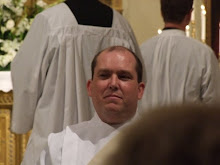
Just before the ordination: The soon-to-be deacon with three rookie priests.

One of the most powerful moments of my ordination--and surely any priestly ordination--was the "laying on of hands," that moment when each of the concelebrating priests, after the bishop, places their hands on the heads of those being ordained. I've always thought it a powerful symbol since it connects us physically and spiritually with the Apostles, who laid hands on their successors who, in turn, did the same. One gets a sense of being something larger as well as knowing the support of one's brother priests, many of who have been friends, mentors and models of priesthood.


This weekend I learned that it is equally powerful to stand on the other side. Three of us from my community who were ordained this summer traveled up to Montreal for the diaconate ordination of one of our community members here in Boston. He was ordained at the same time as two new priests from his province (French Canada). So, I had the opportunity for the first time to lay hands on some new priests, just 10 weeks after my own ordination. And it was just as powerful from the other side. Indeed, since the entire liturgy was in French, and my French is pretty rusty, such symbolic actions and gestures took on added significance. There was no need to translate. The three of us also had the privilege of concelebrating the first mass the next day, at which our new deacon assisted.

It was a grace-filled weekend during which we got to meet several of our French Canadian Jesuit brothers for the first time. They couldn't have been more friendly and hospitable!

What a humbling privilege to find myself part of this "chain" of grace.

Wednesday, August 27, 2008

Give Me My Name

“Our celebrant today is . . . I don’t remember his name, so he’ll have to introduce himself . . .”

So I was introduced at the beginning of one of my masses this summer. One could take offense. I didn’t. But I did wonder if it was symptomatic of something I’ve been noticing all summer, with varying degrees of comfort. I have a new name. That name is “Father.” Even people who do remember my name are prone to calling me not Father Mark or Father Mossa, but simply “Father.” And if that were not enough, some people insist on punctuating nearly every sentence with it in the course of conversation. Now don’t get me wrong; I know they are just being respectful. But I don’t always feel worthy of such respect, especially from those who have been living a good and devout Christian life a lot longer than I have been.


In many religious communities people used to—and some still do—begin their life with a new name. My friend Frances, who recently joined the Trappistines, is now “Sofia.” One of my favorite high school teachers, Brother Alois, started his life as “Donald.” So, getting a new name is not something foreign to religious commitment. And, indeed, I would often be mistakenly called “Father” during my Jesuit formation, but most of the time only when I was wearing clerics. One of the most disarming things that happened right after ordination was having people call me Father when I wasn’t wearing clerics! They’d been, most of them, witness to the event, so they knew who I was. The secret was out.


This summer only heightened my awareness of this new name, because I found myself being introduced to most of the people I would come to know in Germany, already a priest. Indeed, in the case of most of the parishioners where I was working, their first encounter with me was when I was presiding at mass. I suspect most of them didn’t even find it necessary to learn my name; it was easy enough simply to call me “Father.”

My concern in all this is not so much being called “Father,” however. I suppose I’m more concerned with the “Mark” getting lost. Not that it would be so terrible, but I don’t want to just blend into some general category they have in their brain. I want them to know the unique me. Not just because I like to be appreciated, but also so that the unique gifts God has given may be best put to use. Does being just “Father” somehow obscure that? I’m not sure. I may be thinking too much into it. Nonetheless, it’s an identity that I’m still not quite used to. Someone says “Father,” and it doesn’t immediately sink in that they are talking to me.

Yet, in spite of all this, I also find myself resisting the temptation to say, “just call me Mark.” This is because I think that I also have an obligation myself to appreciate and respect my new identity. As much as I know myself to be just like everybody else, there is at least one way now that I am not like everybody else, and cannot be. I’m an ordained priest not because I crave respect and adulation or whatever, but because God has called me to be this. So as uncomfortable as I may be being called Father, I am equally if not more uncomfortable with inclinations I might have to make little of it. It smacks of artificial humility rather than the real humility which is required—accepting the vocation God has called me to, and its consequences. But there is also more to me than just this particular vocation. So maybe in addition to “Father,” maybe there could be also be a “Father Mark” once in a while. Just so I don’t get lost.


Sunday, August 24, 2008

New Home

The last week has been quite busy, thus my absence. I returned to the States in time for the young adult retreat in Atlanta. It was a great weekend. In addition to a few talks, I heard confessions, and presided at Sunday’s mass. It was a real privilege to be able to do so much. I’ve been doing retreats since I was a teenager, but this was different because now I had a different role. Indeed, much of it was new. It was the team’s first time doing this retreat, and our first time working together. Because I was in Germany, I did not have the opportunity to really get to know them before the weekend, so it took some getting used to each other. Little things needed to be negotiated, like assuring them that it was not necessary to defer to me when it came time to pray. And, of course, I still have to get used to people referring to me as “Father” so often, which I will say a bit more about in a future post.

Then, it was off to Florida for a few days to visit my parents, and contend with Tropical Storm Fay, which kept us at home for most of my birthday. We had to postpone our day trip to Sarasota until Thursday. By then the storm had moved further along enough that we had a nice, pretty day there, with a few sprinkles, but no rain.

Now I’m two days back home in my community here in Boston. Things are familiar, but again very new. I return to a new house, and return as a priest. There are new faces, old faces have gone, and I’m not quite sure exactly where I fit in with all this. But I’m looking forward to seeing how my new life back at home comes together . . .

Friday, August 15, 2008

Newly Busted


My friends over at Busted Halo are basking in the glow of their new web design. Check it out! There you can also find the homilies of Paulist Father Dave Dwyer who, along with Mike Hayes, hosts the Busted Halo podcast.

Anniversaries & New Beginnings

These are days replete with significance for me and many others. Yesterday, August 14, marked 11 years as a Jesuit for me (I entered August 14, 1997), and two months as a priest. Today, August 15, is the 9 year anniversary of the day I took my first vows in 1999.

Today, also, I'm remembering in a special way the group of novices from my province who this morning pronounced their first vows: Paul Frederick, Marcus Fryer, John Hough, Stephen Pitts, and Sylvester Tan. They will leave the novitiate to begin their Philosophy studies in New York, Chicago and St. Louis. And, God willing, they will also find themselves in 8-9 years ordained priests. Please pray for them.

I'm unable to be with them today because I'm in Atlanta preparing for the retreat I'm working on, which begins tomorrow. We have about 35 young adults coming to participate in the retreat, which is exciting! Please pray for all of us as well!

On Tuesday, August 19, the Company magazine bio of me will cease to be incorrect, as I will be celebrating my birthday.

Sunday, August 10, 2008

Last Homily in Frankfurt


I was pleased when I saw the readings this week. How appropriate that I should finish my time here with my "first parish" with the Gospel story depicted on my ordination card! Indeed, Peter's walk on the water is one of my favorite Gospel episodes, one that has brought me much consolation in my years as a Jesuit. And I enjoyed the chance to reflect on it in the context of Elijah's encounter with God in that "tiny whispering sound" in the first reading. So, here it goes:

One of the most frequent questions I hear from people on retreat is: How do I know that it is God speaking to me in my silent prayer, and it’s not just my mind telling me what I want to hear? It’s a great question, and I can relate to it because I often ask myself the same thing. And it’s not an easy one to answer. Save for God appearing and speaking to you directly—and even then you’d probably think yourself crazy—it’s hard to be sure. How did Elijah know, in the first reading today, that God wasn’t in the earthquake, the wind or the fire, but instead in that small whispering voice? Save for the fact that he was a prophet, and thus should know such things, who knows?! At this moment Elijah was on the run from people who wanted to take his life. It’s a wonder he didn’t grasp on to the idea that God would manifest himself as something thundering and violent. Yet, perhaps he simply recognized that at such a time it was not more violence that was needed, but rather a whispering calm. In any case, I think we’re meant to take note of what happens next. When Elijah recognizes God he moves to the front of the cave. He comes out of hiding and waits for God to tell him what’s next.

This is actually an apt metaphor for our prayer experience. And this is what I tell those who ask me about it. Like Elijah, we look for God. And, like Elijah, we trust that God’s presence will be made manifest in our lives. In answer to that recognition, we too have come out of hiding. We open ourselves to God. So, why wouldn’t God speak to us? Why wouldn’t God take advantage of that openness in prayer and reveal to us what’s next. And God inevitably does. Sometimes God just confirms what we were thinking already, for certainly God was already working. But sometimes God does something that comes as a total surprise.

When God does speak to us in prayer, and I think he does far more often than we recognize, this is usually an invitation to obedience. If you’re looking to be a rebel, here’s your chance, because this is one of the most countercultural things about our faith. Not only that we would talk to God, and claim that he speaks with us, but that we would let God tell us what to do! In a world that worships independence and self-determination, people will think we’re crazy not so much because we claim to speak with God, but that we would do something contrary to our own will in order to serve God’s will! And their objections will only become louder and more thunderous if, as sometimes happens, things then don’t go so well.

Six years ago I found myself in just this kind of situation. I’d finished the first part of my seminary studies, and was looking forward to a few years of active ministry before returning to studies. There was a plan in place for me to go and teach English at one of our high schools. I was really excited, and looking forward to it. However, about six months before I was to start, I was asked to consider another position. Not teaching, but directing the campus ministry and community service programs. I was not happy. I’d already told my formation director that an administrative type job would not suit me well, but he insisted I consider it. I did, then returned to him and repeated my objections, adding that I would do whatever was asked of me and try my best. I was asked to do it, and tried my best to do it well, but I couldn’t hide the fact that I was just barely keeping my head above water and that the work was making me miserable. I thought: If I weren’t a Jesuit, I would just quit. Indeed, I’m not sure I would have made it if it hadn’t been for the presence of a couple of Jesuit friends, and my work outside the school directing two women through a retreat in daily life, where we encountered just the kind of questions about prayer I was speaking of.

After a year of basically overworking myself, the principal expressed no appreciation for my work, but instead not so nicely invited me to leave. And my religious superiors were starting to wonder about my future as a Jesuit. But by then I had already realized for myself that something new was happening. I realized that despite my desire to just quit the job, my confidence in my vocation as a Jesuit and a priest had not wavered, even if now it was being called into question. Also, what had been happening at that same time was that I had already received an unexpected invitation—from someone who had no idea what was going on with me at the high school—to come and teach at Loyola University in New Orleans. I spent a very happy and successful two years there during which even I was amazed at the things I was able to accomplish, and the doubts of my superiors were soon put to rest, more or less.

I realized then why, for reasons I couldn’t have anticipated, a few years before I had found myself so drawn to the story in today’s Gospel reading. As with Elijah, this is a story of recognition. Peter and the Apostles think they’re seeing a ghost as Jesus walks toward them on the water. Yet, in response to Jesus’ voice, Peter does what many of us would like to do when we are trying to sort out whether or not God is really speaking to us: He kind of dares Jesus to prove himself, saying, “If it is you, command me to come to you on the water.” And Jesus says, “OK. Come on.” Like Elijah stepping out of the cave, Peter offers to Jesus his obedience, by stepping out of the boat and, amazingly, finds himself walking on the water. Now a lot of people want to see this as a story of failure. But I want to say, wait a minute! Did you notice that Peter walked on the water? Jesus told him to, and he walked on the water! Yeah, then he started to notice the high winds, and began to sink, just like the winds of independence, self-reliance and doubt can get in the way of our attempts to answer God’s call to walk on the water as well. But, at least he stepped out of the boat! And he and Elijah both highlight for us today, what I also learned during that miserable year: When we choose to trust that we are hearing God in our prayer, when we choose despite our doubts and even perhaps contrary to our own will to be obedient to God, we’ll probably find what Peter did. We’ll sometimes find ourselves doing more than we ever imagined we could, and we’ll sometimes find ourselves miserable and struggling for air. Yet, either way, like Peter, we’ll always have the confidence that we’ll be heard when we cry out, “Lord, save me.” And we’ll also have the confidence that God will respond.

Friday, August 8, 2008

Atlanta Bound


A week from now I'll be back in the states to help out with a young adult retreat at our retreat house in Atlanta. I'm really looking forward to it, though I expect I'll be a little jetlagged. I'm also looking forward to having the opportunity of visiting with the Jesuits there. The retreat house, and the Jesuits, were featured in a recent article in the Atlanta Journal-Constitution. If you're a young adult in the Atlanta area, think about joining us. You can find information about the retreat here. Here's a little snapshot of Jesuit life from the above mentioned article (the photo above includes some of the Jesuits in question):

When the priests aren't conducting retreats, they are often preparing sermons to deliver in local parishes and counseling spiritual seekers, said the Rev. Albert Louapre, known as "Father Al." They also must handle the more mundane facets of life such as laundry and cooking —which often involves a can opener.

After Mass on this morning, the priests gathered in the kitchen to make their breakfasts — four men darting from refrigerator to sink to stove to toaster. Around the breakfast table the conversation turned toward the seminary attended by Louapre, 78, and the Rev. Niel Jarreau, 81.

"The older generation," cracked Salazar, 64.

In response, he got a perfect lip-vibrating, tongue-extended raspberry from Jarreau.

Wednesday, August 6, 2008

Twelve Baskets Full: Last Week's Homily


In past weeks the readings have challenged us with threats that if we don’t step up as Christians, that if we don’t plant firm roots and do the kinds of things Jesus asks, we risk being thrown into the fiery furnace, where there will be “wailing and grinding of teeth.” We tend to prefer to fast forward past these parts of the Gospel so that we can focus more on readings like those for today’s mass, which promise that nothing can separate us from God’s love and God will give us all that we need. This is the future we’d rather imagine for ourselves—God accomplishing miracles to heal us and to feed us, not the pain of being separated from God because of our actions. Or, because of our inaction.

Despite the sunnier tone of today’s readings, Jesus’ response to the Apostles in today’s Gospel, “Give them some food yourselves,” challenges them, and us, not just to act, but also not to fail to act when others are in need.

We begin every mass with the penitential prayer, “Lord, have mercy.” But in the longer version of that prayer we are more explicit, confessing and asking forgiveness for, “What I have done, and what I have failed to do.” While we mustn’t live our lives consumed with regret, much good can come from asking the forgiveness of others for ways in which we’ve failed. Most of us who show up to Mass each week probably aren’t spending a lot of time deliberately hurting others by our actions. Our failures tend to be a bit more subtle, but just as real, and potentially just as problematic.

My point, however, is not to dwell on this but instead to propose that today’s readings might help us to understand why we often fail to act as we should, and how we might do better.

Today’s readings are hopeful and reassuring. God says, “Come to the water,” I will provide everything for you! Saint Paul reassures us that “nothing can separate us from the love of God revealed in Christ.” This is what we want to hear.

But think a little more abut what is being said here. God is saying you don’t need to worry about yourself: I am everything that you need. And Christ is showing us, through all that he does for us, that nothing can separate us from God’s love! Just think about that for a bit longer. Now, ask yourself: Do I really believe this? Do I really live it?

I must confess that as much as I’d like to answer with an enthusiastic and unqualified “yes!” to these questions, I have to hesitate a bit. See, I often find myself in situations in which I feel that if I really believed that God was going to take care of everything, I would be doing things differently. Why? Because I tend to play it safe, rather than to give extravagantly like God says he will in the first reading. I think: If I really believed this, I would be giving more money to the poor, putting more in the collection basket, and be living more poorly myself, not always putting that little bit aside “just in case.” I’d be feeding more hungry people. I’d be responding more quickly to those I encounter who are in need, rather than worrying about the risks involved, the consequences, or how it might inconvenience me. If I really believed all this, simply put, I would take more risks and live more radically, in a way more like what I spoke about in last week’s homily. In a way more like Jesus did. Maybe you have had a similar feeling.

But this precisely where the hope in today’s readings lies. Because, like me, you probably have a deep desire to believe these things wholeheartedly. I know that despite my frequent failures, because of that desire, each day I find myself believing it more and more. Growing in this desire has convinced me that the more our belief in God’s generosity, protection and love guides those things that we choose to do, especially those things that we could easily and without significant consequence walk away from, the more we will find ourselves doing amazing, even miraculous things for God and for others. We will love others in ways that seem foolish, but that we know are holy and right. So that when we find ourselves in impossible situations like the Apostles do in today’s Gospel—thousands of people and almost nothing to feed them with—we won’t try to send them home, we won’t even need Jesus to tell us “give them something to eat yourselves,” because, with Jesus’ help, and perhaps risking everything, we will already have found a way to do it. And we will stand back in awe when we see how much we have left over.

Tuesday, August 5, 2008

A Rookie Trappistine!


Congratulations to my good friend Sister Sofia Millican (she's the happy young woman in the middle), who just received her veil and is now officially a novice (I think). Wish I could have been there. I can't wait to go out there and say mass for the sisters when I get home!

Sunday, August 3, 2008

Once a Rookie Soccer Player . . . Now a Future Priest

New England Revolution defenseman Chase Hilgenbrinck has retired from Major League Soccer in order to enter seminary.


"I certainly didn’t want the call to pass me by and regret it later. When the Lord comes knocking, you have to answer the door. I really had no choice. I can’t say no. I want to live for the will of God, and that’s doing what he wants of me and not what I want necessarily. Doing the will of the Lord is wanting what he wants for me."

Saturday, August 2, 2008

The Flying Host Incident


Well, I knew it was going to happen sooner or later. Apropos of my previous post about receiving the Eucharist (which, by the way, The Irish Catholic asked if they could publish!), I had a communicant who chose to receive on the tongue, but didn't give me much to work with! So, I did my best to try to get it in there, and the next thing I knew, it was flying through the air!

Well, as you can imagine, what followed was flying vestments in a panic! Trying to retrieve the host from the floor--and at the same time not lose the rest--I found myself feeling not only panicked but also embarrassed and angry. Not exactly what I want to be feeling when I'm distributing Holy Communion!

Nevertheless, I recovered, made it on the second try with a new host, and then finished with the rest of the line. Then there was the somewhat unpleasant but unavoidable question of what to do with the lipstick-stained host that I had retrieved from the floor. There was only one thing to do--consume it. Which I did.

The moral of the story, I guess: These things happen, and you do what you have to do. Still, I felt a little bad about getting angry. Nobody said anything, so I hope I was able to keep something of a poker face.

The Rookie Priest Files: James Martin, SJ


I thought it might be nice for you all to hear now and then from a priest besides myself about his experience of the early days of priesthood. My friend and brother Jesuit, James Martin, has been kind enough to provide the first installment:

The Spirit is in Charge!

A few months after my ordination in 1999, I was scheduled to celebrate a Mass at St. Ignatius Loyola Church in New York City, where I have my regular Sunday assignment. When I opened the schedule of readings for the week, I was delighted to discover that it was one of my favorites: the story of the Annunciation, from the Gospel of Luke. While I was praying about that passage, it dawned on me that the story of Mary's interaction with the Angel Gabriel perfectly encapsulated our own spiritual lives. God took the initiative with Mary; Mary questioned; God reassured her; Mary said yes; and God brought something new--Jesus--out of her "yes." How often that is with us--we sense that God is asking us to do something new in our lives; we question whether we can do what God asks; God reassures us; and when we finally say "yes" something wonderful happens.

Anyway, I was eagerly anticipating the reactions of the congregation to my supposedly wonderful homily. So, on that Sunday, I preached with great fervor, and, after Mass, waited for the inevitable praise. What did I get?

Crickets.

That is, nothing. Not even the standared "Nice homily, Father." It was rather baffling. What happened?

The next week was a busy one for me and, uncharacteristically, I wasn't able to spend a lot of time on the homily for the next Sunday. So on Friday I more or less dashed it off. Nothing special, just some reflections on how we can meet God in the everyday, finding God in all things, and all that.

I delivered it tentatively that Sunday, as if knowing that I was giving the congregation only a mediocre effort.

The result?

Afterwards people approached me in tears, telling me how moved they were. "Thank you so much, Father!" "So helpful!" "Beautiful!"

It didn't take me long before I realized that those two homilies had taught me something about preaching: something that both consoled me a freed me. Pray and prepare of course as much as you can. But remember that, ultimately, it is not you who move people's hearts. It is the Holy Spirit who does so. The Spirit is in charge--not you!

James Martin, SJ is a Jesuit priest and author of "My Life with the Saints" and "A Jesuit Off-Broadway."

Internal Dialogue: Conspicuous Guests


"Looks like two Legionaries in the congregation--should I be nervous?"

(Actually, I spoke with them after mass. They were very nice.)

Thursday, July 31, 2008

Autobiography of a Pilgrim, Founder, and Priest


If you had a look at the Company magazine article which I linked to below, you may have noticed that a number of us who were just ordained are 40 years old or better. Even considering the fact that the article has my age wrong, I'm still 40 years old. During my Jesuit formation I sometimes got a bit discouraged by the fact that I wouldn't be ordained until I was 40, but I always took consolation in the fact that our founder, Saint Ignatius, was older than 40 when he was ordained and, besides, waited over a year before saying his first mass!

Today is the feast of Saint Ignatius. So, in celebration, I have added to my sidebar something I wrote a couple of years ago (so in places it is a little dated). It is the complete text of Saint Ignatius' autobiography, divided into small parts which you can read a day at a time, accompanied by a reflection after each part. It offers some nice insight into the life of Ignatius before he founded the Jesuits and became a priest, as well as some insight into my own life before priesthood. If you're not interested in the latter, the posts always begin with the selection from Ignatius' autobiography. You could simply read that, and skip the rest.

Happy Feast of Ignatius Loyola! Many blessings on you!

Tuesday, July 29, 2008

The U.S. Jesuit Ordination Class 2008


Company magazine, a magazine of the U.S. Jesuits, has published its latest issue which includes details about the men ordained in the U.S. this year. Check it out here.

A bit more information on our new priests can be found at the US Jesuit webpage.

My Parish


I've only been a priest for about six weeks, but already I've fielded repeated questions about "my parish."

The truth is that I don't really have a parish.

Most people's understanding of the priesthood is according to their experience of being a member of a parish, where there is usually a permanent priest assigned, usually a diocesan priest. So it is not surprising that most people would think that all priests are assigned to a parish. This, in fact, is not the case, especially for priests like myself who belong to a religious order. Yes, some of us do spend time working in a parish. However, at least as far as Jesuits are concerned (and I expect this is true of many other religious priests), many if not most of us are unlikely to be permanently assigned to a parish in the same way a diocesan priest is (diocesan priests are often assigned to parishes for a minimum of six years at a time, and often end up staying longer). Even Jesuits who are assigned to a parish often after several years are assigned to another ministry. Our association with a parish, then, tends to be different than that of diocesan priests, the majority of whom spend most of their priestly lives in parish ministry.

How is it different? Well, take, for example, my current situation. I do have a parish, in a sense, as I am currently the only priest regularly serving the parish here. Nevertheless, I am not "on the books" as the pastor, another priest who lives here is officially listed as the administrator of the parish. It is also an international community of people who worship in English here in Germany, one in which the community takes a lot of responsibility for what happens in the parish. I, more or less, just show up to say mass, hear confessions, etc. Yet, still, it is "my" parish, in a sense, for at least the next few weeks. For better or worse, the community has had only me saying mass and preaching for about two months. So, we've developed a relationship, and I have the luxury of being able to refer back to things I've said previous weeks, hoping they might remember (!).

Some here have asked what parish I am going back to, and I've had to explain my situation. Though I am a new priest, I have been missioned to further studies, not to a parish. This does not mean I will not be working as a priest. What it means is that I have to find some regular work for myself as a priest. And, as you might imagine, there is no lack of opportunity. What I am hoping is that I will be able to be involved in some of the student liturgies at Boston College, and I will also try to arrange with a local parish for me to come each weekend and take one of the masses there.

As a religious priest, then, one becomes something of a guest in the places where he offers mass. This is nice in one sense because I don't have all the responsibilities that come with a parish. I can come in and bore or inspire the people (hopefully the latter!), and then go home again. It also has its challenges because, since I am a guest, I don't have the luxury of doing everything precisely the way I would want to do it. Each parish has its own peculiar way of doing things and, as a visitor, it is not necessarily my place to insist on doing things otherwise. If they were guilty of some egregious error, I might have to take a stand, but usually this is not the case.

I must admit I kind of like this way of being priest, because you get to meet a variety of different people, and it fosters the humility required to appreciate approaches to worship that, given my own preferences, I might not otherwise be involved with. I get to experience the richness and diversity of the Catholic faith from a rather unique perspective, while also experiencing the wonder of the one common Eucharist we share, and this whether I find the community's approach to worship joyful, prayerful, or exceedingly dull. Christ comes there to be with us whether or not the community is inspired, whether or not the music is good, and whether or not I say the mass perfectly while I try to do things their way.

So, I guess "my parish," then, is not a place, but rather a unique mix of experiences, with a wide variety of people, who I am grateful to have the opportunity to serve as a priest.

Saturday, July 26, 2008

Cologne


I escaped Frankfurt for about 24 hours and went to Cologne. Below is the interior of the Jesuit Church there, on the left the Cathedral. There I also had the pleasure of meeting Theresa, a theology student at the University in Bonn, who I have been corresponding with for a while. She discovered my blog a while back, and got it in touch. I'm glad she did! We had a very nice time.

Wednesday, July 23, 2008

Back in the Day

There were only two of us to give our first blessings at my ordination. But here is how it looked back in the day:


Georgetown University, circa 1925
(close to 40 Jesuits ordained in one place in one day!)

Tuesday, July 22, 2008

No Politicians Here, Just the Green Priest

Somebody found my blog searching for this: "Jesuit Priests in US politics"

And I'm not even in the US!

I HOPE they were disappointed with what they found.

Monday, July 21, 2008

A Little More Than Just Internal Dialogue

It's not always easy being green.

So, yeah, there was that brief memory lapse on Saturday night. But at my final mass on Sunday, which is at a different church than the other two, things kind of took a turn for the worse.
Before mass I forgot to do one thing that I usually do--check the Sacramentary to be sure it's ready, all the ribbons in the right place, etc. This I didn't realize until after I'd already processed to the altar to begin Mass. Which is not too much of a problem because I only need the book for the prayer which comes just before the readings. That page, thankfully, was marked. But, not only was the book not set up for mass otherwise, it was not the Sacramentary I usually use! This one is set up a little bit differently. So, instead of being attentive during the readings, I was fumbling through the book, hoping not too many people were noticing. I managed to get things more or less in place before I had to get up to proclaim the Gospel. And, actually, of the three versions of my homily this weekend, this one, I thought, turned out the best. Then, back to mass.
I was so flustered by having the wrong book, I forgot the handwashing. I didn't realize this right away. No, I realized this a short while later, which caused me also to wonder: did I skip more than that?! This distraction, then, messed up my gestures for that part of mass, but I also managed to figure out that I'd only skipped the handwashing. So, Phew! No questions about the validity of mass.
So, I thought I was out of the woods until I realized that I hadn't marked the page for the prayer after the Lord's prayer, which I usually have the book open to for that part of the mass. So, a little bit of panic as I realized this was going to have to be from memory, and if I got stuck this could be really embarrassing. I'm happy to say the memory worked, and we made it through the rest of mass without a hitch. I'm not sure how aware the congregation was of all that drama, but it was a humbling reminder of the fact that every mass need not be perfect to be prayerful--and valid!

The Sixth Sunday Homily (Still in Germany)

You have to wonder a little after the Gospel readings for the last two weeks: Why is it that the Apostles keep asking Jesus to explain his parables? Shouldn't they, of all people, know what he's talking about? In fact, didn't Jesus say that they were the ones who were supposed to get the parables, as opposed to those who didn't recognize Jesus for who he was? And if the Apostles didn't get it right away, maybe this means we have to think a bit about where we stand.


I used to teach poetry. Most students hate poetry. And they don’t hate like they hate brussel sprouts, or asparagus, or some other kind of vegetable people tend to dislike. They hate it because it intimidates them. They hate it because when it comes to determining the “right” answer, most have come to one of two conclusions: the right answer is secret or hidden, and it’s too much work to try and figure it out; or, there is no right answer, so what’s the point? To a certain extent, their frustration is justified. Because when it comes to poetry, there is no single “right” answer. However, this does not mean, as some then conclude, that any answer is right, nor does it mean that there are no wrong answers. When it comes to an individual poem, there are many ways in which it might be interpreted correctly; there are other ways which might initially seem correct but, upon further examination, can’t be justified; and then there are many ways which can be easily shown to be wrong, if it is not already obvious. The key to arriving at a good interpretation of a poem—and this is another reason why students are frustrated—is that you can’t just read it once, and then make up your mind what it means. You’ve got to stay with it, read it a few times more, consider how others have interpreted it, look at it in terms of its own historical context, pay attention to how it moves you, consider how it might speak to people today, put it aside, and come back to it again. The key to arriving at a good interpretation is to be open to discovery, being willing to see how you might have gotten some things wrong, so as to better understand and even live in the reality which the poem explores. Unfortunately, in a semester course, in which students are most concerned with what grade they are going to get, few are going to be convinced of how worthwhile such a process of discovery might be.

But our life as Catholic Christians, fortunately, is more than a semester course. And the process of discovering what it means to be a “good Catholic” is not unlike interpreting a poem. Those of us that make a serious effort at living the Catholic life “rightly” will experience some of the same frustrations as that poetry student. At first we might think that we have it pretty much figured out. But then we look at it again and again, and things that we once thought we had right don’t seem to work anymore. We meet other people who have been at it longer who show us a new way of approaching things, or we meet younger people with new understandings which shed new light on our old prejudices about how one must go about things the “right” way. Soon we realize that it is impossible for us to get it right once and for all, and not have to worry about it anymore.

One of the things that should make all this easier, but just as often seems to make it harder, is that we are all in this together. We’re all stuck with each other, all of us at different places in our attempt to live the life that Jesus has called us to as Catholic Christians. We don’t all go to our own private masses on Sunday. No, we all come together here, no matter where each of us in that process of discovery, here to share our common belief in Christ and to worship together, the weeds and the wheat.

This image from today’s gospel of the weeds and the wheat is an image that Saint Augustine was especially fond of. He insisted that there was no other way to live together as the people of God, because in the end only God could tell the difference between the weeds and the wheat. The rhetoric doesn’t seem as prevalent here, but in the U.S. these days there are many Catholics who, unlike Saint Augustine, are not content with this state of affairs. There are people, often good people, convinced that they know what it means to be a good Catholic, who’d rather not have those who think otherwise as part of their Church. They exist among those who call themselves liberal, conservative, traditional, progressive, or whatever. Some may be very direct about it, others more subtle, but you can find intolerance in every corner. But this attitude, no matter which side it comes from, always strikes me as particularly unCatholic. For anyone who has taken the time to come to know the poetry of Catholicism, and I mean not literally poetry, but Catholicism’s history and tradition, knows that part of the beauty of being Catholic is belonging to a diverse community in which over two thousand years people have found so many different and inspiring ways to live as a Catholic. The beauty which one discovers must not be mistaken for the “only” way, as it is only a facet of a complex reality. One need only look at the thousands of religious families—Jesuits, Franciscans, Benedictines, Dominicans, etc. which have grown up with the Church to see that the Church itself has throughout history recognized many different ways of living this life, and this is not to mention the many vibrant movements of lay Catholics which the Church has recognized in just the last 70 years or so.

When we become too convinced with the “rightness” of where we are in the Christian life, and the wrongness of where others are, we run the risk of not recognizing the possibility that we may have placed ourselves among the weeds rather than the wheat. Today’s readings call us not to certainty about our Christian lives, but to humility. Saint Paul, especially, reminds us that we must know our place and be open to the work of the Holy Spirit not just in others’ lives, but especially in our own. The entire text is short, and worth repeating. He says:

Brothers and sisters:
The Spirit comes to the aid of our weakness;
for we do not know how to pray as we ought,
but the Spirit himself intercedes with inexpressible groanings.
And the one who searches hearts
knows what is the intention of the Spirit,
because he intercedes for the holy ones
according to God’s will.

Let’s pray today that, especially as we endeavor to live together as a Catholic community, that our desire to be right and to live rightly might not interfere with our trust in the work of the Holy Spirit in the lives of others, and especially in our own.


Sunday, July 20, 2008

Confessions


Because of the seal of confession, I hesitate to say too much. But my experience so far has made me realize that the circumstances of the confessions we practiced in our cases in class were rather ideal. They presumed you had only limited pressure as far as the time you could spend. But, when someone asks for confession 15 minutes before mass, the time you can spend is limited. I'll admit to feeling torn. I don't want to deny somebody the Sacrament, but I also regret having to rush through it. Nevertheless it seems more important to allow someone the grace of the Sacrament rather than insist on having the ideal situation. I have to trust that the Holy Spirit, as the readings for this Sunday suggest, will make up for our shortcomings. It also helps me appreciate more the opportunity I have when someone comes for confession and I'm not so rushed.

Saturday, July 19, 2008

Internal Dialogue: Panic Mode

While singing the Gloria:

"Oh my God, I've totally blanked on what comes next."

Seconds later: "Oh, wait, I know."

Continue singing the Gloria . . .

then, "Let us pray . . ."

Milestone


This is the "before" shot, taken after my last time serving as a deacon, at the first mass of Fr. Bill Murphy, S.J. (center) in Chicago, a week before my own first mass. With us is our good friend and housemate for two years, Fr. Dani Villanueva, S.J., from Spain.

Wednesday, July 16, 2008

Rookie Recording Artists . . .

. . . who just happen to be priests.


I'm not sure how I feel about them taking the name for themselves. Indeed, "Holy, Holy, Holy" would probably be more interesting. But, nonetheless, this more positive story about priests can't hurt these days!

You can learn more about them here.

Tuesday, July 15, 2008

Internal Dialogue: Music

When the choir hits a particularly sour note:

"Try not to make a face"

Monday, July 14, 2008

Anniversary


It's July 14. I've been a priest for a month. It's been an intense month. Seems like longer. Somebody said after mass the other day that it appeared like I've been doing this for years! Must be grace . . . Happy Anniversary to me!

(That makes it also about a month for the Celtics, so I couldn't resist)

The Post-Mass Letdown


It's especially acute, I think, because I'm somewhere where I don't really know anyone very well. But, nevertheless, I expect this is an experience many priests probably suffer from.

Presiding at liturgy is not only a moment of intense personal prayer, it is an even a more intense communal experience. Different priests probably have different levels of awareness of the people they are praying with, but I haven't found myself getting so lost in the mass that I forget there are several hundred people there praying with me. This is probably a good thing. I started singing in choral groups and choirs from a young age, and so I still simply by habit look at people when I am singing (in this case also praying), not only looking straight ahead, but looking around. I take note of the faces, and have to take care not to get too distracted by the many things going on out there! I am also very conscious during my homilies of whether the community seems "with me" or not. My experience as a member of the congregation has been that some priests manage to be blissfully unaware of whether or not this is the case. But I hope I never get there.

So, this means that when we come to the end of the mass, I've just had an intense experience of community. I also find it important to be there to greet people as they leave, so that experience continues even after mass to a certain extent. But then comes the moment to head back to the sacristy and get out of my vestments. I'm left alone, while everyone else has gone off to do whatever is next. It's not hard to feel suddenly very lonely, especially here in a city where I barely speak the language. That doesn't mean the people here have been completely inattentive. I was invited to join some of them for dinner after my first mass here. And, the weekend before last, one of the ladies in the parish just outside the city where I also celebrate mass (almost as if somebody knew I was feeling this) offered to bring me to a local festival, which I enjoyed very much.

One of the things that exacerbates this, no doubt, is the shortage of priests. After my first mass on Sunday morning, the people gather for coffee and refreshments, and then some pretty regularly go out together for breakfast afterwards. I'm not able to join them, however, because I have to rush off to the next mass at another church. I don't resent it, and I'm glad I'm able to do it, but this prevents me from getting to know the people at either community as I would like to. But since I suspect I'm not the only one experiencing this sort of thing, I thought it might be good for people to know. If the priest at your parish doesn't have to rush off to the next thing after mass, maybe he would like to join some of you for breakfast or lunch! It wouldn't hurt to ask.

In the meantime, I'm thinking I just might have to be proactive as well and make some plans beforehand to meet up with some people after mass!

Saturday, July 12, 2008

The Saturday Night Dilemma

So, tonight I had the 5:00 pm mass, and tomorrow I have the 9:30 am.

Tonight during the homily, about half way through, all the faces went kind of blank. I seemed to have lost them. So I was thinking: Maybe I need to change the homily for the morning.

However, after mass I was informed that evidently about the time the faces started going blank, the microphone had cut out. So, many people in the church couldn't hear me at all.

So, was it the homily, or was it the microphone?

I think I'll sleep on it and make some adjustments in the morning . . .

Thursday, July 10, 2008

Video Highlights of the Ordination

For those of you that weren't there, and those who were who would like to relive it, there are now video highlights of my ordination posted on-line:


Watch it here.

If, like me, you are having trouble viewing the video on the province website, try
this version posted on Facebook (for Facebook members).

Tuesday, July 8, 2008

The Things You Notice More . . .

Once you start presiding at mass regularly, you start to notice things you either hadn't before, or had, but not with the same frequency. One thing I've noticed in these first weeks: I have to begin the response, "Lord, I am not worthy to receive you . . ." If I don't, or if I hesitate, I throw the congregation off. Who knew?

I have also become much more conscious of what I don't quite want to call "pet peeves" because, while they are things that bug me, they aren't unimportant or silly as, I assure you some of my other "pet peeves" are.

The one that is on my mind these weeks has to do with receiving the Eucharist. Now I've not yet had anything so bad as the communicant who, according to a Jesuit friend, came to communion talking on his cell phone, but I am tempted to give an instruction on receiving the Eucharist. Now, I'm sure that my readers are not guilty of such things, but maybe you could tell your friends. This is what I would say:

First, and this might actually make the difference, consider that the Eucharist is something that you probably actually want to receive. How might you approach the Eucharist as if it were something you really wanted?

Second, imagine if someone were about to give you something that you not only really wanted, but also really needed, where and how would you hold your hands to receive it? Would you hold your hands so low that the person would have to risk back injury to give it to you, or just casually stick out one hand as if unconcerned where what you are receiving might end up? Or wouldn't you hold both hands up high, near those of the person giving it you, so as not to lose something precious?
Note
: when you don't hold your hands up high, you cause confusion, because the priest or eucharistic minister, not seeing your hands, will presume you're receiving by mouth, the result being further confusion when you don't open your mouth.

I was a child when communion in the hand was first introduced, and I think the way we were trained to receive still works well: Hold your hands high, left hand placed over right, so that the Eucharistic minister can easily place the bread into your hand. It's that simple.

Third, patience. "Amen" is a response. You're saying "yes" to something! Don't preempt me by saying "Amen" before I say anything. Wait until the priest or eucharistic minister says, "Body of Christ," and then say "Amen." And you silent types, overcome your shyness and at least say "Amen," don't just stand there and say nothing. Also, it's not a time to chat, so stick to "Amen" and avoid such things as "how are you?" and "have a nice day!"

Fourth. You may never have considered this, but priests and eucharistic ministers of my age (40) and younger tended to be brought up receiving communion in the hand, or at least knowing that was the way the majority of people received. So, as a result, when you come for communion by mouth, this can be a source of anxiety. There is more danger of something going wrong, like dropping the bread, or touching someone's mouth. This is not to discourage anyone from receiving this way, but just FYI. You can help alleviate that anxiety, and protect against such accidents by opening your mouth fairly wide, and sticking that tongue out (not all the way).

Fifth. It was because of things like this that the Church recently asked people to bow their heads before receiving communion. This is good for helping you to remember that the Eucharist is something you actually want to receive!

Finally, a note on intinction. Some people have become accustomed to dipping the bread in the wine, and then receiving the bread that way. This is actually the common practice in some eastern rite Catholic churches. But most people do not intinct the way it is supposed to be done. The proper way is to hand the bread to the eucharistic minister and let them dip the bread in the wine. They can then give it to you on the tongue.

Again, I think the first thing is more or less the cure for all ills. Remember that the Eucharist is something that you want and need, and is worthy of reverence. The rest, then, would more or less take care of itself.

Sunday, July 6, 2008

First Assignment?

One of the more frequent questions put to me in the last several weeks has been: "What is your first assignment?" Or: "What parish will you be working at?" So, I have to keep explaining that I haven't been assigned to a parish and that, indeed, most Jesuits are not assigned to parishes. Though there are some Jesuits, and priests of other religious orders working in parishes, most of the priests who work in parishes are diocesan priests, priests of that particular diocese who come under the authority of and are assigned by the local bishop. Their "first assignments" are typically to a parish.

My "first assignment," on the other hand, is to continue my studies. Though I am now a priest, that will be my primary task for the next few years. This does not mean I will not be working as a priest. However, instead of being "assigned" to a particular parish, I will, when I return to Boston, establish some kind of regular schedule of priestly ministry. This could be at a local parish, or perhaps in campus ministry at the university. I will find some place where there is a need, and offer my help. Since I did not return to Boston after ordination, I have not yet had the opportunity to get that set up.

Nevertheless, this summer I am working as a parish priest, of sorts. Generally, after ordination we are expected to at least spend the summer working as a priest, usually in a parish situation. In my case, I also had another goal for the summer as well: to learn German. And so I found myself a job working as a priest in Germany, while I study German.

No, I'm not inflicting my horrible German on some poor parish! I'm serving as a priest to two English-speaking parish communities in Frankfurt, Germany for the summer. I have three masses per weekend. Two at a twelfth-century church here in Frankfurt, on Saturday night and Sunday morning, and one more Sunday morning at a church built in the last half-century in a suburb of Frankfurt. It's a fascinating situation to work in. The Frankfurt community is a fascinating mix of people, English speakers from numerous countries who have come here to live and work. The People come from Asia, Europe and North America primarily, though we have people from other parts of the globe as well. There are even some Germans in the community who prefer the English liturgy to that of the German churches they have been to. The other community is mostly ex-patriate Americans, though there are also people there from a number of other places. They are both lovely communities, and I'm enjoying the work very much, especially the opportunity to work in such a multicultural context, while also learning a lot about German culture in the meantime!

It's also interesting being "the priest" amidst my fellow students at the language school, where I completed my first week on Friday. Most of them seem to have a limited religious "literacy," and so they have lots of questions! Once we establish first that Jesuit is not another religion, then I can tell them a little bit more about the richness of the Catholic tradition of religious life, and my experience of being a priest thus far. This is the second summer in which I have spent a good bit of time among people for whom God and religion is not necessarily a big part of their life, not necessarily because they are hostile toward it, but just because for whatever reason it has not been a big part of their lives. I spend so much time in religious and Catholic circles that I think I sometimes forget how many people like this there are out there. And it seems as if the number is growing. I'm starting to wonder whether something that God might be calling me to in the future is outreach to such people. My experience has been, like I said, that rather than being hostile toward Christianity and Catholicism they are rather quite interested in knowing more about it. I don't feel it necessary to proselytize. I just answer their questions. Who knows where that might lead?

In many ways, then, what I'm doing now is my "first assignment," and I'm finding it a nice way to start my life as a priest. And it will be a good experience to carry with me as I continue my studies and my priestly ministry back home.

Saturday, July 5, 2008

The Fourth Sunday Homily (Second in Germany)

Well, it's been a few days because this was my first week of German language classes. I came home each day pretty exhausted, and with hausaufgaben (that's homework) to do!

And, as you'll see, the experience of this week had more than a little influence on this weekend's homily!:

“Come to me, all you who labor and are burdened, and I will give you rest.
Take my yoke upon you and learn from me,
for I am meek and humble of heart;
and you will find rest for yourselves.
For my yoke is easy, and my burden light.”

As I listened to those final words of the Gospel today, I couldn’t help but be struck by the apparent difference from the message of our readings in the previous two Sundays. Last week, the readings shared the theme of rescue, and seemed to be warning us that our belief in God and our choice to follow Jesus will often find us helpless and in need of rescue. And one clear message which came through in the readings the week before that seemed to be that our following of Jesus would not only at times find us helpless, but also that we would suffer for it. So, what a relief to hear from Jesus today: Come to me, all you who labor and are burdened, and I will give you rest . . . for my yoke is easy, and my burden light. This is the message we’ve been waiting for! No helplessness, no suffering, but rather, this is going to be easy! Does Jesus’ invitation today mean we can just forget about those other things he said? Or is Jesus contradicting himself?

As I pondered this question, a rather obvious analogy presented itself to me. Most of you here today are people who are living somewhere that requires you to speak a language that is not your own. And that required that somehow you had to learn the language. So, you already know the helplessness and suffering involved in making such a change in your life. Yesterday, I finished my first week of learning to speak German. There are few things that leave me feeling as humiliated and helpless as learning a new language. One day it seems like I’m starting to get it. The next day I’m wondering if I learned anything the past few days. And I don’t know about you, but this is much like my experience of being a Christian. One day, one week, I’m on such a roll, doing precisely the kind of things God has been asking me to do, and I start feeling pretty good about myself. I’m starting to get this Christian thing! Then I find myself doing something really awful to somebody, or getting distracted by things not of God, and I wonder: have I learned anything in thirty years?

As followers of God, as Christians, it seems that we are always trying to learn the language. And readings like our first two today serve to remind us that it is a language often foreign to our experience. God’s dominion, Zechariah, tells us comes not from violence, war and domination, but by proclaiming peace to the nations! And Saint Paul tells us over and over again in his letters, as he does today, that we must forego the language of the “flesh” and learn the language of the “spirit.” We need only read the newspaper or watch the evening news to realize that in this world where war rages in so many places and many people know nothing of God, this will not come easy. But we can take comfort in the fact that Jesus’ invitation is not to those who find life easy. He says “come to me all you who labor and are burdened, and you will find rest.

Jesus’ invitation isn’t offered to those who find life easy, with a promise that life will continue to be that way. No, he presumes that we are laboring, that we are burdened, trying to learn the language of the Christian life. A language in which dominion comes from peace and not war. A language in which our material desires are transformed and replaced by the desires of the Holy Spirit, and the desire of Jesus for a world in which all will come to know God his Father as he does. Learning this language, like learning any language which is not one’s own, puts us in situations in which we are helpless, unable to understand what someone is trying to say to us, and suffering from the humiliation which comes with it. Our pride is taken away, and we find ourselves dependent upon others, even for the most basic of things. This, by the way, is a good time to remember that this is the daily reality for many in our world.

But, if we continue to labor, carrying the burden that each time we take a step forward we soon seem to be taking a half step—or even two steps—back; If we stay with it, we eventually find ourselves at that wondrous moment when those conversations which we once seemed like so much noise, suddenly start to make some sense! Soon, it’s not so much effort to speak or even understand the language. We needn’t translate every word. It starts to come more naturally. Indeed, I except some of you have been here long enough that at times you need to say something in German, because you can’t remember the English word! The language has not changed, but we have. In a significant sense, we have been made new. How much greater, then, if in our Christian lives, we can get to the point where we can’t even remember how we used to think or do things, because we have become so accustomed to living as Christ calls us to live—living lives filled with generosity, faith, hope and love. Our burden becomes lighter, our work easier, because we have come to know how to speak the language of the Spirit, even though as with any language there is always more to learn.

And the greater ease which comes with living this language of the Spirit frees each of us to do what we are called to do: to teach others to speak it too.

Tuesday, July 1, 2008

The U.S. Ordination Class of 2008

Each year the US Catholic Bishops' Conference collects information on the men being ordained that year. This year's class was my class. You can even find a photo of me on the bishops' website! You'll also find some interesting commentary and statistics like this:

“We are blessed with the enthusiasm the newly ordained will bring to the mission of the Church,” said Cardinal Sean O’Malley, chairman of the bishops’ Committee on Clergy, Consecrated Life and Vocations. “We pray that through their good work and example more men will generously respond to the Lord’s call to serve as priests.”

The report reflects a response rate of approximately 84 percent of the 401 potential ordinands reported to CARA. These 335 ordinands include 242 ordinands to the diocesan priesthood and 77 ordinands to the religious priesthood. Another 16 ordinands did not specify whether they were being ordained to diocesan or religious priesthood.

CARA also found
  • Most ordinands have been Catholic since birth, although close to one in ten (9 percent) became Catholic later in life.
  • Half of responding ordinands (51 percent) attended a Catholic elementary school, as have almost half (49 percent) of all Catholic adults in the United States. However, ordinands are somewhat more likely than other U.S. Catholic adults to have attended a Catholic high school and they are much more likely to have attended a Catholic college.
  • Ordinands were active in parish ministries before entering the seminary, with between about half and three-quarters indicating they served as an altar server, lector, and/or Eucharistic minister in their parish.
In other findings: the youngest ordinand is 25 and the oldest is 76 years of age. Five ordinands are being ordained to the priesthood at age 65 or older.


Get all the info here.