Reading Already There?

There's more to the experience than just the book. Find it here.

Wednesday, January 6, 2010

The Promised and Long Overdue Wedding Post


This is for George
So, the wedding:

It’s been nearly two months since my first wedding, and so I’ve had some time to reflect. It was both a wonderful experience and, in some ways, a lonely experience. This is not a criticism, or an effort to make anyone feel bad. I think it’s meant to be that way for what one realizes are obvious reasons. The focus is not meant to be on me at the wedding, but on the couple. Thus, the more I fade into the background, the more the attention is properly placed. It seems to me that, if you’re doing it right, as a priest you do become something of a fifth wheel. You don’t want people fawning over you. You want people’s attention to be focused on the couple, and on enjoying the celebration. But that doesn’t mean there isn’t a bit of loneliness that comes with it. The same thing is true sometimes, as I have written about before, right after mass on Sunday.

All that said, what a privilege! What a privilege to be there to witness two people in love making a lifelong commitment to each other, and to witness the love and care that their families and friends have for them. From this perspective, the rehearsal dinner the night before provided some of the most moving moments. The parents, brothers and sisters shared great and humorous stories and expressed with emotion and honesty their love for Cara and Paul, the bride and groom. I teared up a little myself when, while listening to the words of his brother and best man, Paul began to cry. Nothing stirs more emotion in me than when people unabashedly express their love and affection for each other. These are the moments in the movies—and in real life—when I always get a little choked up. I knew that I didn’t want to be up too late the night before the wedding, but I waited until the parents, the best man, and the maid of honor had their say, before making a stealthy exit. I didn’t want to interrupt the great things that were happening by making a show of my departure. And, given the lay out of the room we were in, there was no way to say goodbye without attracting much notice.

The rehearsal and the wedding were not unlike what happens when I visit a parish to say mass for the first time. I want to know how they do things, and they want to know how I want them to do things. Eventually, I have to make some kind of affirmative statement about how I want to do things, even if it’s the way they usually do things anyway. And it usually is. There are, of course, a few things I don’t compromise on, but usually these things are not at issue. So, I say, why don’t we do this . . .

This situation was a little bit different, because I had never witnessed a wedding before. So, I tried to tell the wedding coordinator, “Tell me what to do, because you know what you are doing, and I don’t.” Still, there were a number of times that I was asked, “What do you want to do, Father?” We got through it. One of the groomsman was actually getting ready to enter seminary (interestingly, I was in the same situation as a groomsman just before I entered the novitiate), so he and I had some things to talk about. What I soon learned as we went along was that the rest of the wedding party knew as little about what we were doing as I did. The only problem was that they were counting on me to know what I was doing! I told them—and myself—to try to remember things as best you can. If you forget, somebody will point you in the right direction.
So, the time for the wedding arrived. I was told that things were laid out for me in the sacristy. Here’s where I gained a little confidence about what I was doing. I knew enough to realize that the vestments on the table were the wrong color! So, I went sifting through drawers and closets to find the right ones. Well, at least I know enough to spot that something is wrong, I thought. As we went along, I learned a few things.

The first misstep was when we got to the Gloria. I waited for the music ministers to begin, and nothing happened. And, of course, everyone was looking at me like I’d forgotten something. When this happens, I always have a moment of panic—did I forget something?! Then I realized that the look was not because I’d missed something, but for one of two reasons: 1)They had no idea what was supposed to come next, or 2)They were waiting for me. Now this whole thought process didn’t take as long as it seemed. When I realized it was just that the music ministers were not singing the Gloria (and that I had not forgotten anything), I began: “Glory to God in the highest . . .” Note for the future: Be sure to check before the mass what the musicians are doing, and especially what they are not doing. I spent the rest of the evening looking over to the piano at any time which might call for music. Strangely, the Alleluia wasn’t sung either. There must have been some miscommunication there.
The rest went more or less as planned. The homily had to include mention of the Yankees, as this was the week which they won the World Series, and I had been teasing Paul, who is a fan, from the very beginning about it. This, of course, is required of any self-respecting Red Sox fan like myself. The Saints, who may yet win the Super Bowl, were not to be excluded either! Of course, this was just in passing. My homily focused mostly on the readings, and on my experience of Paul and Cara during the many months they had been preparing for their marriage. At the reception, by the way, there were two cakes: The traditional wedding cake, and a cake made in the shape of a Yankees cap. The latter was obviously made by someone not well schooled in baseball, as the frosting was the wrong shade of blue.

A well-established, though perhaps little known fact, is that the priest usually gets seated at table with someone’s aunt(s) or uncle(s) and, frequently, one of the crazy ones. Those at my table didn’t seem too crazy. This is actually one of the more interesting—and apostolic—parts of the wedding experience. You get to meet some very interesting people. Not only relatives, but friends of the family, parents or significant others of members of the wedding party, etc. Most of them haven’t really had the opportunity to sit down and speak with a priest for a long time, if ever. So, it is an excellent opportunity to be for them a positive experience of Christ and the Church. Many priests I know have told me how so often at weddings they have the opportunity to reconcile somebody with the Church in some way. You never know when you might have the opportunity to do that for somebody, or that it might happen without you ever realizing that you had that impact. This is another reason why I think it is important to keep in mind that, while I sort of get to be at center stage for part of the time, the wedding has little to do with me. Yet, hopefully, my presence for those days, and during my privileged time of guiding them through their preparation, will help them to make God a lasting part of their love, their family, and their life together. Ultimately, the sacrament is about them and God, not about me. But what a privilege it was—and is—to be there!

Tuesday, December 1, 2009

Still Going . . .

I've been preoccupied with some health issues lately--not to mention classes--but as you can see from this article on the Fordham website, I'm still managing to do some ministry. It even quotes a previous blogpost!

Enjoy! I'll offer some reflections of my own on the experience of the last couple of months soon.

Blessings for Advent!!

Monday, October 12, 2009

I'm Still Alive, Really!

All the energy I put into finishing the writing of my book this summer, and moving, not to mention starting a new graduate program here at Fordham, has left me lacking in both time and creative energy. So, that's why you haven't heard from me in a while.

I'm enjoying my new community here a lot. Both the larger community, and the Jesuit community in which I live. I've already had an opportunity to be involved in several masses with the students, which is something I wasn't really given the opportunity to do at BC. I've also started helping with mass and confessions at a nearby parish, which I can walk to!

Lots been happening. So I will have some reflections soon. But right now, I've got a paper to write.

Some have asked about the book. I have received my Imprimi Potest, but we're still seeking some permissions for, of all things, use of song lyrics. The book will appear late summer of next year.

Hope everyone had a nice holiday weekend--if you had one.

In Other Words . . .

Suck it up, Father! You're a pastor, and they're sick.


A certain amount of discomfort and suffering comes with the job.

Thursday, September 3, 2009

Amen! Thank You, Cardinal O'Malley


Thanks to Cardinal Sean O'Malley for saying what desperately needed to be said:

"Advocating for the dignity of life is central to my role as a priest and a bishop. One of my greatest satisfactions in my ministry thus far was helping to overturn the abortion laws in Honduras. The person who answered my call for help with that effort was Dr. Bernard Nathanson, who had been a prominent leader in NARAL and the abortion rights movement. His own change of heart led Dr. Nathanson from a practice of providing abortions to becoming one of the most eloquent exponents of the pro-life movement.

Helen Alvaré, who is one of the most outstanding pro-life jurists, a former Director of the Bishops´ Pro-life Office and a long standing consultant to the USCCB Committee for Pro-Life Activities, has always said that the pro-life movement is best characterized by what it is for, not against. We are for the precious gift of life, and our task is to build a civilization of love. We must show those who do not share our belief about life that we care about them. We will stop the practice of abortion by changing the law, and we will be successful in changing the law if we change people’s hearts. We will not change hearts by turning away from people in their time of need and when they are experiencing grief and loss.

At times, even in the Church, zeal can lead people to issue harsh judgments and impute the worst motives to one another. These attitudes and practices do irreparable damage to the communion of the Church. If any cause is motivated by judgment, anger or vindictiveness, it will be doomed to marginalization and failure. Jesus’ words to us were that we must love one another as He loves us. Jesus loves us while we are still in sin. He loves each of us first, and He loves us to the end. Our ability to change people’s hearts and help them to grasp the dignity of each and every life, from the first moment of conception to the last moment of natural death, is directly related to our ability to increase love and unity in the Church, for our proclamation of the Truth is hindered when we are divided and fighting with each other."

Read his whole post on his blog here.

Tuesday, August 4, 2009

"Dutch"


When things got a little tough for me in my early years as a Jesuit, my friend "Dutch," (above, right, vesting me at my ordination) an older Jesuit priest, could always be counted on to provide a listening ear, and words of affirmation. Recently the New Orleans Times-Picayune ran a story about him:

Jesuit priest shares stories of a lifetime

Sunday, July 26, 2009

By Sarah Druen

. . . Why write about the Jesuit experience? The short answer is because I recently had the great privilege of becoming acquainted with a group of retired Jesuits who live in Algiers at the Ignatius Residence, located at 6321 Stratford Place.

In particular, after visiting with 83-year-old the Rev. Tom "Dutch" Jenniskens, I was inspired by his reflections and remembrances and given his blessing to share these various gems with you, our eager readers.

Jenniskens may never have become a Jesuit or served at Jesuit High had it not been for his own father's acts of courage and unselfishness. In answering Monsignor Peter Wynhoven's plea to assist in the staffing at Hope Haven, Jennisken's father relocated from Holland to Marrero, serving as a lay missionary.

Initially, the greatest need was in getting the dairy started and following the enlistment of the Salesians, the focus shifted toward working with the needs of the boys.

In 1945, the young Jenniskens, who had graduated from Jesuit High in 1943, was confronted with one of the most important and difficult decisions of his life. The U.S. was in the middle of World War II and Jenniskens knew without a doubt that he had a vocation to the priesthood. Although Jenniskens' brother, Peter, chose to become an archdiocesan priest, Jenniskens knew his call was to become a Jesuit, yet he was torn because of a desire to contribute to the war effort.

Ultimately, Jenniskens chose to serve his country by pursuing his religious vocation. To this day, Jenniskens recalls not only his frame of mind, but his exact location when he made his final decision. While sitting up in one of the windows, by the fish pond, Jenniskens received the grace of conviction, stating, "I knew this was where I belonged and I never looked back." . . .

You can read the whole story here.

Wednesday, July 29, 2009

The Theologian as Dead Frog

After reading this article in The Chronicle of Higher Education by someone who identifies himself as "theistic off the job and professionally agnostic,” I'm wondering if I should reconsider my Theology studies. He explains:

“Theology [as opposed to religious studies] also views itself as an academic discipline, but it does not attempt to advance knowledge. Rather, theologians practice and defend religion.”
How can theology be so unambitious?


“Since rituals do not accomplish what the religion says they do, the researcher evaluates them on the basis of what they actually accomplish, even when the doctrines do not acknowledge those accomplishments.”
It seems I should also reconsider my vocation as a priest.


“In sum, the religion researcher is related to the theologian as the biologist is related to the frog in her lab. Theologians try to invigorate their own religion, perpetuate it, expound it, defend it, or explain its relationship to other religions. Religion researchers select sample religions, slice them open, and poke around inside, which tends to "kill" the religion, or at least to kill the romantic or magical aspects of the religion and focus instead on how that religion actually works.”
Can somebody explain this to me? As far as I can tell, this analogy doesn't make any sense, because shouldn't the religion researcher then be dissecting the theologian? And, if so, wouldn't that make it hard for the theologian to invigorate or perpetuate anything? Unless, perhaps, maybe after dissection the frog is resurrected? But, then again, this might not "kill" religion, but start a new one. I'm confused. And, besides, I don't want to be the dead frog. Maybe I could be a virus?


Also, apparently, if I want to persist in being a priest and a theologian, I'm going about it unethically:
“The failure of theologians to remind the members of their churches and synagogues that the Bible is an anthology of ancient literature composed by ancient people in an ancient culture has consequences. The laity are entitled to know that any god described in a biblical text is an ancient god, a byproduct of the ancient culture that produced the text. The god of the Bible is the sum total of the words in the text and has no independent existence. It would be reasonable to begin every theological discussion with the disclaimer "the god described in this sacred text is fictional, and any resemblance to an actual god is purely coincidental." This is not an outsider's dismissive opinion, but the reality, and theologians have an ethical obligation to teach that truth even if they also want to believe and teach, as is their right, that a god exists.
"

But, thank God, it seems that my qualms may be unwarranted. He wants to reassure me:
“Am I trying to imply that theology is without value? Certainly not.”


So, maybe it is safe to step back into the sanctuary, and the classroom. And, in case you were wondering, I checked: not from the April Fool's issue.


Sunday, July 19, 2009

I'm Good

You never know how things are going to come across on the internet. I've had a few kind messages from people, thinking I was upset or down, because of the post (since removed) which at least two people described as "raw." It wasn't as raw as what I had originally written for myself, and it was trying to express something I've been thinking about for some time. So, it wasn't really as raw as it seemed. But since it was interpreted that way, it's probably better that I removed it. I can assure you that I am not down or upset, but actually quite the contrary.

Indeed, I've had a lovely couple of days. One of the things that's great about being a Jesuit priest is that we have this great network of people who are graduates of our educational institutions. Since I am a graduate of Fordham university, I received word that there was a group of Fordham alumni coming to New Orleans this week to assist Catholic Charities and Operation Helping Hands in some of their ongoing rebuilding work. Knowing I was going to be here at the same time, I contacted them and invited them to the parish for mass. They kicked off their week with an alumni reception here in town last night. So, I joined them and some other local alumni last night for drinks and hors d'oeuvres in the French Quarter, and they joined me for mass this morning at 11:00 am. After mass, I joined them for an afternoon around town. So, it's been a really enjoyable couple of days with a group of young alumni, all of whom have graduated within the last ten years. Many of them used their vacation time from work in order to come down here for this trip.

This is truly one of the perks of being a Jesuit. I have enjoyed seeing many of the great positive contributions my former students are making in the world. And that's only a small percentage of the alumni I haven't taught myself from other schools, like this group from Fordham (actually several of them were students at Fordham at the same time I was a student). What a privilege to spend some time with them these last two days! I know they are going to do great work here this week.

So, yeah, sometimes there are the conversations that are a little lacking in Christian charity, and in sensitivity toward people I care about, but that's one of the "perks" too. Knowing the success of our work, witnessed to by the generosity of our Jesuit alumni, helps outweigh the criticism of those who fail to see the good.

So, really, I'm good.

Saturday, July 18, 2009

The Voices in My Head

So, the book manuscript has been submitted, which is a relief. But with that comes the back and forth reevaluation in my head. Maybe that part wasn't really finished. That part was really good. Does it really all come together? Does it provide what I wanted it to? Yes, there's enough there that many different people will be able to getting something out of it. Did I limit the audience too much? Or not enough? Blah, blah, blah.

I expect this is normal, and I'm counting on editorial feedback. And, of course, there is always the fear that they'll return it and say: This is really awful. But I'm pretty certain that won't happen.

In the meantime, I'm throwing myself into my summer work as a parish priest. And starting to look ahead to other things like moving, the young adult retreat I'm working on next month, my own retreat, and a new school year at a new school. So, I guess it's helpful that stuff is running around my head as well!

For Some, I Must Be the Agent of Darkness

Today I again had one of those experiences where as a priest I feel like I just have to sit silently, and hope that maybe God gives me something to say, if God wants me too. And, if not, God will take better care of things than I can . . .

A friend expressed some concerns about this post. So, I've removed it, at least for now, to consider his concerns.

If you're interested in my thoughts, feel free to write me at my e-mail address.

Friday, July 10, 2009

Output

My creative energies have been focused elsewhere lately. So, I hope you have not been "put out" by my absence.

My book, which has been floating far too long in the ether, is nearly complete. I'm not sure why it has been such a prolonged effort, but I hope it will prove to be worth it. It has been a fascinating experience of inspiration, frustration, change and nurturing. Chapters moved, titles changed, and the realization that it will never be quite "done." How much to explain? How much to leave to the reader? The hope and the trust that ultimately it will be up to the reader to finish, for it is for him and her and them after all.

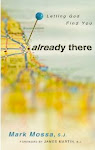
This is all to say that my lack of blogging ought soon to produce a material reward, in 2010. Here's a description, I prepared for the publisher:

Part memoir, part cultural critique, part Christian apologetic, Title Yet to Be Finally Determined is Jesuit Fr. Mark Mossa’s spiritual primer for young adults searching for God in their life. “You may have noticed that there are not a lot of Catholic Christian spirituality books out there that speak to your experience,” he says to the reader, “I noticed that too.” This book is Mossa’s attempt to begin to make up for this lack, by delving deeply and honestly into his own young adult experience. While doing so, he invites the reader to agree to one key insight, which provides the book’s basic structure: “Whether we like it or not, each of us has a past, present and future. And . . . they’re connected.”

Indeed, as the title suggests, Mossa’s book is all about making connections. That, he says, is what the spiritual life is all about. It has to be more than just a vague feeling of self-transcendence. True spirituality, he insists, must connect us with God, and other people. Drawing inspiration from sources as varied as Marlon Brando and the Psalms, Gerard Manley Hopkins and Kermit the Frog, Adam Sandler and U2 he invites young adults on a journey to finding God already present and active in their lives, in their relationships and in their culture.

Along the way, by also sharing his own successes and mistakes, and the lessons he learned from them, he hopes to offer insights more suited to the complexities of life in the late 20th and early 21st centuries. What does it mean to allow myself to love and be loved? Can I ever really forget the pain of my past life? How do I discover the unique life that God is calling me too? Inviting young adults to embrace what he calls a “spirituality of desire,” Title . . . seeks to start them on the path to an adult spiritual life, one energized by the common human desire to be with God.

Sound interesting? I hope so.

I have promised to submit the manuscript Monday, and there is only a little and much to do between now and then. So, see you on the other side.

Please pray with me that my finishing touches will be sufficient, for now.

Saturday, June 20, 2009

Friday, June 19, 2009

May We All Be Enthralled by Christ

From the Holy Father's declaration of "The Year of the Priest" which begins today:

To the Most Holy Virgin I entrust this Year for Priests. I ask her to awaken in the heart of every priest a generous and renewed commitment to the ideal of complete self-oblation to Christ and the Church which inspired the thoughts and actions of the saintly Curé of Ars. It was his fervent prayer life and his impassioned love of Christ Crucified that enabled John Mary Vianney to grow daily in his total self-oblation to God and the Church. May his example lead all priests to offer that witness of unity with their Bishop, with one another and with the lay faithful, which today, as ever, is so necessary. Despite all the evil present in our world, the words which Christ spoke to his Apostles in the Upper Room continue to inspire us: “In the world you have tribulation; but take courage, I have overcome the world” (Jn 16:33). Our faith in the Divine Master gives us the strength to look to the future with confidence. Dear priests, Christ is counting on you. In the footsteps of the Curé of Ars, let yourselves be enthralled by him. In this way you too will be, for the world in our time, heralds of hope, reconciliation and peace!

May our faith be deepened. And may we everyday become better servants of the servants of God.

Sunday, June 14, 2009

Celebrating the Gift of Being a Priest and a Jesuit

On a Monday morning two weeks ago in Quebec, the Poor Clare community got a rare treat. My newly ordained Jesuit brother Andre had come to say mass for them. And with them he brought two Jesuit deacons (soon to be ordained themselves) and three Jesuit priests, including myself, to concelebrate. It was a wonderful celebration, and each of us even dared to make a contribution to the prayer, in French. The Sisters held a reception afterward for Andre and, as we gathered round, they insisted Andre tell the story of his vocation. It was in French, of course, so I was only able to get the gist of it, not all the details. But when he was finished, I completely understood when one of the sisters commented (in French also), “So, you’re a young priest, but an old Jesuit.” We laughed, but also nodded our heads, because what she said was true.

Today I celebrate a year as a priest. And it is truly something to celebrate! I love being a priest, even though it has only been one year, and there are still so many “priestly” things I haven’t done. So, no need to change the name of the blog. One year in, I’m still a rookie. But I have also been a Jesuit for almost 12 years, and that, to me, is just as much cause for celebration. That’s why I’m glad that today was pretty low-key as far as anniversary celebrations go. I didn’t preside at a mass to celebrate the year. Instead, I concelebrated the first mass of another brother Jesuit. Then, I enjoyed the day with several other brother Jesuits—spending the afternoon in the city, going out to dinner, seeing a movie and just talking. A fitting way for this “old” Jesuit to celebrate the gift of my “young” priesthood, a gift inseparable from whom I have become because of my brother Jesuits and, of course, the people whom I’ve had the privilege to minister with and to. Next week I’ll celebrate with them.

Saturday, June 13, 2009

Frontiers Not So Foreign, or Far Away

One of the exciting things about being a priest, especially a Jesuit priest, is that we are not always sure what kind of situations we might find ourselves in that demand our ministerial skills. The recent General Congregation spoke several times, as has the Pope, about how often as Jesuits we are especially called to be on the “frontiers” of faith and culture. Some of my most privileged moments of connecting with people have been outside of typical “church” contexts. Traveling from one place to another, for example, you never know what kind of need you might encounter. Often there’s a chance to help someone, or listen to their story in a way that is part of my priestly vocation, even if that person doesn’t even know that I’m a priest (I don’t wear clerics 24/7). But I also like it when I’m with a group of people, my fellow German students last summer, for example, in which I just happen to be a priest sharing an experience with them. A lot of the time the fact that I’m a priest doesn’t make a difference, but there are times that it does. There are the conversations—what’s it like? And there are the times when people do have a need to talk about something, or ask for help, and they know that I’m someone who they can probably count on.

I’ve noticed recently that I run into a lot of people that I would term “religiously indifferent.” They’re not hostile toward God or religion. And they are often very good people. However, for some reason, it hasn’t occurred to them that God should be a part of their life. It makes me wonder what it would be like to be “chaplain” to a group of people that one is not typically chaplain to. Like bikers, circus performers, journalists, buskers, CEOs or something like that. Those are interesting “frontiers” one could explore!


Father Jim Martin has offered a peek into just such an experience in his book A Jesuit Off-Broadway. Don’t let the title fool you. This isn’t a light-hearted reminiscence on one Jesuit’s brief dalliance with the New York theatre world. It is a remarkably engaging and often deeply moving account of being a priest on the frontiers of faith and culture, of finding God in new and surprising ways. He almost seamlessly moves from his account to being theological advisor to the off-broadway production of The Last Days of Judas Iscariot to reflections on some of the most profound theological questions, and does so by showing us how the troupe of actors which he came to know and love struggled with those same questions. Fr. Martin admits to being a little star-struck at first, especially having the likes of Philip Seymour Hoffman as the play’s director. But he soon enough got over that to see how real these people were, and how serious they were about honoring the lives and beliefs of the characters they were portraying—Saint Monica, Saint Thomas the Apostle, Judas, Jesus, Mother Teresa, etc. As his story progresses, we witness not only the sometimes uncomfortable birth of a work of art, we see how Fr. Martin and the cast are transformed by the experience. All this is placed in the context of the Christian tradition in a revealing and enlightening way, and as one continues to read, one starts to feel as if they know and love this group of people, just as Father Jim comes to know and love them too. And one sees how the Spirit works in varied and surprising ways because a priest has been introduced into what at first seems a “foreign” context, but which eventually is revealed by compelling portraits of each of the cast members, as a place—a holy place—not so foreign at all. I think I’ve become this book’s biggest fan.

One of the most moving parts of the book for me, came at the very beginning, in the foreword by the playwright, Stephen Adly Guirgis. He explains:

“I asked many questions that, perhaps, one is not supposed to ask, and, on occasion, Father Jim would reply with answers that perhaps he was not supposed to give. I tried to—and needed to—leave no stone unturned, and Father Jim, secure in his faith and his priesthood, never did anything but supply direct answers to pointed questions. And he did so kindly, thoughtfully, and with both a passion for the subject and a wealth of com-passion for me—his confused, often irate and disconsolate lapsed Catholic Interrogator. In short, he was everything I think a Priest should be: caring, thoughtful, strong, unimpeachable—and up for the challenge. In short, I have no doubt that Father Jim is one of Jesus’ true soldiers. And trust me: I’m not the doubt-free type. I drown in doubt, and to the degree that that’s true, Father Jim, from our first meeting and right up to today, is slowly teaching me to swim.”

Friday, June 12, 2009

Google Humor

So, I just discovered that this blog is the first result for the following search:

something a person use to wipe their mouth with

Too funny!

(especially because the point of the post was--don't wipe you're mouth with it!!)

"Food" for Thought (and Prayer)


I'm taking some time to reflect on Pope Benedict's latest message to priests, on the Feast of Corpus Christi:

“Being Eucharist! This must be our constant desire and duty so that the sacrifice of our existence accompanies our offering of the Body and Blood of Christ at the altar. Every day, from the Body and Blood of the Lord we find that free and pure love that renders us worthy ministers of the Christ and witnesses of its joy."


That's just a taste. More here.

Wednesday, June 10, 2009

Where am I? What am I doing? What mass is this?

One of the nice things about being a religious priest is that you frequently get to celebrate mass with several different communities. This, however, can also be a challenge. If I remember, I remind myself before mass about the specific practices of a particular parish, or even a specific mass at the same parish, because sometimes they do things differently on weekdays and weekends. However, it is often the case that I have to take a moment in the course of mass to stop and think, especially if I've been on a "roll" and have spent several weeks doing the same mass. This forces some improvisation at times, either on my part, or the part of the liturgical ministers. If I've poured all the wine, and I wasn't supposed to, that can make it difficult to offer communion under both species as planned. Or if the wine is already poured into separate chalices I might forget that the wine in the main chalice is for me alone, and pour too much. One parish offers communion under both species. One doesn't. One does on the weekdays, but not on Sunday. Each community has its own way of distributing communion, so I try my best to be in the right place, but that doesn't always work either. And, of course, there are the times when the "last-minute recruit" ministers get confused, so that while I'm trying to hand one my ciborium after communion, she instead hands me hers!

Trying to keep this all straight can be even more of a challenge those weeks, like one I had a while back, when I find myself saying mass in six different places in one week! I depend on people when I arrive to tell me what to do, how they do things, etc. This at times takes a little coaxing because many are apt to defer to me and say, "whatever you want, Father." After which I have to convince them that what I really want is to do things the way they are accustomed to doing them. It usually gets worked out. However, we still don't always get things straight. Recently, after a music director told me they were singing "everything," we had a very awkward silence when it came time for the "Gloria." As we discovered, once I asked in the middle of mass, "everything" meant "everything but . . ." Most recently, when offering daily mass somewhere for the first time, the server whispered to me halfway through mass, "Do you know we have adoration after mass?" No, I said, nobody told me that, just tell me what to do . . .

You only have to be a priest for a little while to realize that those that obsess over everything in the mass being "perfect," are doomed to be disappointed. As much as everyone involved makes the effort to ensure that it is reverent, prayerful and perhaps even inspiring, there will always be those little gaffs which remind us that our worship, as our lives, is beset by human frailty. And I expect this is as it should be.

Now, where am I?

Wednesday, June 3, 2009

'Tis the Season!


Ordination season has begun. Please pray for our new "rookie" priests. This weekend I had the pleasure and privilege of attending the ordination of one of our newest Jesuit priests, Father Andre Brouillette, SJ, of French Canada. He's pictured above with Cardinal Marc Ouellet, the presiding bishop. Still a new priest myself, it brought back a lot of the feelings of my own ordination less than a year ago. And it was especially moving because I got to share it with my friend and his family (even if the language gap made communication a challenge at times--my French is very rusty). It was also a community event, as several of us traveled from Boston to be there with Andre. Below, you can see Father Peter Nguyen, SJ, who, like me, was ordained last year, laying hands on Andre (I was in line right behind him).


In the United States, all our new Jesuit priests will be ordained in the next three weeks. Some of our international brothers who study here with us will also be ordained then, as well as in July in August. I know many of them, and they will be a great gift to the Church. But I also know they face many challenges. So, again, please pray for them, and all the rest of us rookie priests.

You can find more photos from the ordination, as well as the Cardinal's homily (in French) here.

Thursday, May 28, 2009

Wait for it . . .

One of my favorite things to do as a priest--believe it or not--is to hear confessions. Some people are afraid to go to confession because they are afraid that the priest is going to yell at them (and, unfortunately, it may even have happened to them once). Honestly, I can't imagine any reason why I would feel compelled to yell at someone during a confession. One might need to be firm about something at times, but there's still no need to yell. Indeed, my experience is that usually it becomes a joyful and healing conversation, once the person has gotten past the difficult part of confessing his or her sins. Sometimes people laugh, sometimes they cry, but it is because it has been a good experience.
Another reason people don't go is because they feel embarrassed because they don't know what to do. I wouldn't let this deter you because, in my experience, nearly half of all my confessions have been with people who weren't sure what they were doing. I'm happy to help. In fact, I often have to stop people from leaving because they've stood up to go before I've had the chance to give them absolution! Also, there's no shame in bringing a "cheat sheet" along with you. Busted Halo has provided a pretty good one, which advises: "Don't get up to leave after that prayer [the act of contrition] because the best part is yet to come: The priest will extend his hands in your direction and he will pray the Prayer of Absolution . . . " So, give it a shot, bring the sheet along with you, and don't run out before you've gotten what you came for!